This writing uses toggle lists; they are prefixed with a black arrow pointing down in the “open” mode. They are like an encapsulation mechanism, you can click them to fold or unfold high or low-level writing subjects. Then there are the links; I suggest you open them in a new tab (in your browser), by middle-click (mouse) on the link, or right-click (mouse) and “Open link in new tab”.
Before I speak, I must understand; what I don’t understand must be left on the un-speakable level (objective). In other words, to be conscious that the “map is not the territory” - or consciousness of abstracting. With that zeitgeist as fundamental, we are ready to launch.
For my purposes, I need to make my understanding of some terms clear (explicit). Opposites like Love and Hate, Care and Neglect, Intelligence and Emotion, Truth and Lie, Good and Bad, Mechanical and Conscious behavior.
I will define my understanding of them and use them as sort of rules of inference in my conclusions.
On Hate and Love
I do not remember myself as a regular user and I find the terms being used upon me in great disproportion. So, the need to understand them.
Prima facie, they seem closely associated with badness and goodness; hate predominantly with bad, love with good;
I find them being used to purely imply each other. So I assume they are used more connotatively. Since these terms are so axiomatic in adults, I will not pick up a dictionary and look up an intentional definition; I will try to understand them in the clearest way humans learn, by means of ostensive definition or extensionality. For these I choose the visual medium, that is movie examples, which may be more demanding (but it’s a good bargain).
Starting with the elementalistic approach - the element for itself in its purest form (as I could observe):
I can not think of better than the old Christian moral: “Turning the other cheek”; which has been ridiculed to high heaven;
Movie example: Adam's Apples 2005 (Scene 22:45) A neo-nazi (Adam) is to be rehabilitated by a priest (Ivan), with other members in rehabilitation. Scene 22:45: Ivan starts a conversation. It turns into a confrontation and ends with Adam striking him on the ground and beating him defenseless. Minutes later, Ivan enters the kitchen on Adam and Gunnar. His face is like “the elephant man” - bloody and disfigured from the beating. His “spirit” thought is intact; he goes about his day like he had an accidental fall, which subsequently made plans to go to the “casualty room”. Gunnar treats him in the same indifferent manner; he asks whether he will pass the market. As if Adam is short of amazement, placid Ivan reveals his absolution, by acknowledging Adam in the room - addressing the birds that eat their apples to him.
As things progress, it becomes more clear that Ivan suffers from the Ostrich effect. It might also be perceived as a clash of both extremes. It ends with both wearing similar clothes to indicate a discovery of similarity among big difference, meaning they both shifted toward the middle.
Movie example: Naked 1993Movie link The movie starts straight away with an act of violence: aggressive sexual behavior and car theft; You would think a hooligan; well, the rarest of its kind - an educated one. The starting scene describes the thick of it: an educated male using his “Anal Emotional-Territorial Circuit”, meaning a “primate” trying to assert himself as dominating or the alpha. If he fails, he flees and repeats. He gives his surroundings the effect that you would get when dazzled with a flashlight at night; He stuns their sense of self with his sophistry and uses that vulnerability to his advantage. After the car theft, he goes to his ex’s town. Her roommate welcomes him and he soon mutilates every human code of hospitality. Quickly grows tired of them, has a claustrophobic attack, and flees back to his vagabond escapades. He does experience moments like the attack, which looks like his conscience leaked a question into his conscious: “Is there a goal to me, mate?”. He has the luck to be welcomed by strangers but invariably alienates them through conspiracy theories, deviant and callous behavior. Eventually, he meets his match; and gets beaten by hooligans for no reason. He “backfires” at his ex girlfriend again, and they get to see him “hit bottom”; She sees the self-torment through tears. They nurse him to sleep. The next morning feels different; you might think another chance is in order. Stimulus presents itself (unclaimed money), that only he can interpret as opportunity. He steals the money left on the table, against rekindling with his ex girlfriend - which perpetuates the self-destruction.
Who's Afraid of Virginia Woolf? 1966movie link The war on nerves on the marital level, triggered by the impartial guests. It can become addictive - if you join the chain reaction of combative intercourse. A battle to the death: who can inflict more imaginative pain on the other? Soon enough, a germ will form - a sadistic sensation of enjoyment. Then you know you entered the game dimension. They walk the thin line between physical and verbal violence. Too ineffable for details.
Movie example: Der siebente Kontinent 1989 (movie link); a family of three is depicted. We are shown repeated and prolonged shots of the most mundane daily chores. The family has little to say to each other. The husband is woken up from dreaming of a dreamy beach. He is asked: what's the matter; He answers: Nothing. Inside a moving car wash, they have silent eerie stares at each other; the wife starts to cry, and nobody inside the car understands and asks why, including her and the car 😊. The husband quits his job and writes to his parent that he did not tell them so as not to spoil their happy moment together. The wife quits too. They intentionally sign out from society, break and tear every object they own, flush all their money, and drug themselves into “deep sleep”. The husband is the last to go; he stares at the TV on static with memory flashes superimposed; it ends with the static overflowing the screen.
You would think people without problems would have finally resolved unhappiness… “Nothingness” is obvious, as big a problem as having too many problems.
Thus, by avoiding problems, they deprive themselves of life’s mystery, depth, diversity, etc.; so whatever is left gets quickly exhausted and turns monochromatic, in effect making them “frigid” or numb. They have nothing interesting to say. They feel like crying but do not know why - as is the strange reaction for a problem of this kind (losing interest in life). The child invents problems where there are not, just to make herself alive. They avoid confrontation with their parents (projecting welfare). The husband is worn down over the similitude of dreams (Pseudo-happiness); he gets nightmares of having too little problems. His answer when woken by the nightmare of a dreamy beach is the foreshadow of the movie's theme - nothing. He is not using a pronoun, he is using the philosophical noun denoting nothingness; He is not dropping a problem, he is stating the problem. The meaning of life is lost; that numbness is confirmed by destroying their affections (possessions). Thus, with nothing to be shown, just a black-and-white life, the static on the TV overflows the screen.
I will address the meaning of the 4 points further down; before that, I will try to propose another relation to the terms.
Lets ask the ontological question: when-where do we find hate or love ? Since the 'observer' and the 'observed' cannot be sharply divided this makes it an epistemological question too.
A living organism exhibits (on the microscopic level) a colloidal behavior of the protoplasm that can be described as a physico-electro-chemical structural occurrence.
”Colloids are pulled together, toward a condition of gel, by their surface tensions. This is because surface tensions pull all glue-like substances together. Colloids are also, conversely, pushed apart, toward a condition of sol, by their electrical charges. This is because their electrical charges are similar, and similar electrical charges always repel each other. In the equilibrium between gel and sol, the colloidal suspension maintains its continuity and life continues. Move the suspension too far toward gel, or too far toward sol, and life ends”
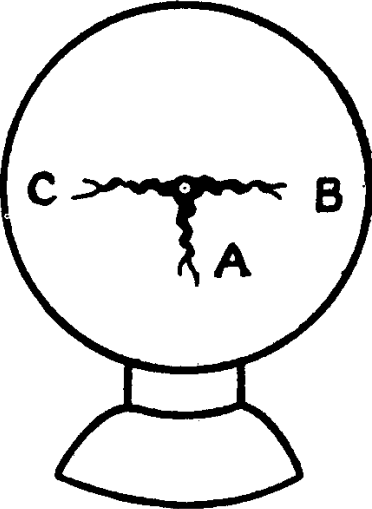
“Let’s take a seed of a plant, for instance, of a squash, and keep it in a moist tropism chamber in the dark; it will grow a root. When the root is about one inch long, we begin our experiment. Originally, under the influence of gravitation, the root grows vertically downwards (A). If we rotate the tropism chamber 90° so that the root is horizontal (B), the root will soon bend downwards under the influence of positive geotropism. The bending does not occur at once, there is a latent period (~10min) after which the root is bent downwards. When we have determined this latent period for a given seedling, we then rotate the chamber to the positions (B), (C), (A), (B), (C) just within the 'time' limit before the bending would occur. We repeat such a procedure several times. Finally, we set the root to its initial position (A).
Without any more changes of position, we observe that the root will wag backward and forward with the period as was used in the experiment. This unexpected behavior will last for several days. It shows that the alternating stimulus of gravitation, as applied to the root, has produced some structural changes in the protoplasm which persist for a comparatively long period after the stimulus has ceased to act. It becomes obvious that teachability and the structural tendency for forming engrams is a general characteristic of protoplasm. ”
Is this to be construed that the squash root learned to love the rotary dance and on its end, it grew tired of it? 😊 I don’t know! What about a bacterium’s tropism (unicellular microorganisms), that follow gradients - “If the quantity of a needed resource, such as food, is increasing, then they are more likely to keep moving in the same direction. If the quantity is decreasing, then they are more likely to turn and try a different direction. A bacterium doesn’t know where it is; it doesn’t have any way to represent its location in the world. It just goes forward and uses a simple rule for deciding when to turn.”
Do these simple rules imply preference; that is love for something and hate for other things? We do use sentences like: Bacteria love sugar-rich environments. Helicobacter pylori loves the acidic lining of the stomach for colonization. Mycobacterium tuberculosis loves oxygen-rich lung tissue. E. coli loves the urinary tract in cases of urinary tract infections.
Yersinia pestis loves the lymphatic system.
Or are this just, anthropomorph’d descriptions?
I think the likely answer would be that a complex nervous system would be required.
Hence, would we describe a wild animal attack on a human as a hate-driven behavior? Unlikely. We would say “it’s his instinct”, or “it’s in his nature”. How about the Darwinian instinct of defending your gene pool; does a wild dog or wolve barking to warn the rest of the pack is a form of love and hate behavior? What about the same behavior with a domesticated dog; that warns the alfa male (human) of an intruder?
How about a robot car that is driving you and upon seeing a wall, it does not break (car crash); Is there a probability to infer hate? Highly unlikely. We would ascribe probability to brake actuator fault or the like. As soon as the human factor enters, would we change probability? If it was a human remote-controlled car or a human behind the wheel? More likely. You cannot certainly rule out suicidal or murderous intent, that is hate toward you, himself, etc.
As is the case in Relatos salvajes 2014, the first story with the airplane. A person’s rumination got on an airplane everybody in his life that made him wrong. With him as the pilot, he crashes the plane to his parents.
In the robot car you might see sinister behavior, but in the human programming of the car, rather than the robot itself.
The Same can be said for the developmental stages of humans (excluding feral cases), up to a certain age (Ontogeny).
The following taxonomy or psychogram or map is only to help me with discreteness. You may find a map with a different naming; it’s what I could find, it’s satisfactory to me and i expect it to be updated.
1. Starting with the Archaic stage (neonate), that is when the baby is using his Oral Bio-Survival Circuit (or neural net).
The Circuit is imprinted by the mother (or the “mother” object) as mostly concentric behavior (safe space) with the oral imprint which involves sucking, feeding, cuddling, and body security which is conditioned by subsequent nourishment or threat. With age, we see more eccentric behavior - further away from the parental object and toward his extended family (Society).
So can we infer hate when a baby is crying, throwing up, pooping itself, etc.. ?
Maybe if they are acting as modeled in the DreamWorks The boss baby 2017 👼 Otherwise, hate is far from the “mind”. We would explain it as instincts, imprints or hard-wired genetic programs, handled by the brain stem and the autonomic (“involuntary”) nervous system, which is interconnected with the endocrine and other life-support systems.
2. At the Toddler and child stage (1-14 years) - The organ erotic or autoerotic and Narcissistic - The Anal Emotional-Territorial Circuit (or neural net).
Humans matured this stage from throwing excretions over a territorial dispute or marking their territory into equally annoying alternatives. ”MOST MAMMALS MARK THEIR TERRITORIES WITH EXCRETIONS. DOMESTICATED PRIMATES(HUMANS) MARK THEIR TERRITORIES WITH INK EXCRETIONS ON PAPER.” It consists of the pre-verbal (kinesics) with “spacial” effects like losing two of your four legs to gain two arms, mastering gravity and straight to “power politics”, that is asserting your status in the pack or tribe or family by “either-or” means of: the “authority reflex” which is to contract the muscles and howl, or the “submission reflex” which is to relax the muscles, lower the head, and “crawl away”. This contrast is roughly connected with either Patriarch (anal) or Matriarch (oral) conditioning on the child, which swings among individuals or societies - the corresponding extremes are of the musculotonic or viscerotonic type. ”In the modern human, it seems to be centralized in the thalamus - the “back brain” or “old brain” and is linked with the voluntary nervous system and the muscles.”
So can we infer hate for a child that has tantrums or manic behavior?
It will be challenging but we will probably avoid such terms and rather use expressions like “ahh dawn kids, it’s their age” similar to the animal: it’s in their nature - the “Dennis the Menace 1993” kind.
It is when a child shows regression from the “Emotional-Territorial Circuit” to the “Oral Bio-Survival Circuit” that most are perplexed. Some will invent other causes as they ascribe to a child, an inept at cunning behavior; Incapability of the evil kind.
Seems like the margin, where you are thinking it, but not saying it yet. Maybe because of counteractive forces that ascribe causes in bad conditioning or lack of it (in the parents), or as Victor Hugo would put it: there are no such things as bad plants or bad men. There are only bad cultivators.
3.At the Social stage or The Time-Binding Semantic Circuit (14 years and on)
The animal as mostly “Space-binder” and the “human” as “Time-binder” by means of the map or the symbol - meaning, humans have an exponential progress or regress time curve, that is we hit the accelerator pedal every paradigm.
Let’s simplify this stage with a movie example; Le fils 2002 (movie link) It starts at a carpentry workshop. We see the attention of a middle age man being drawn to some paper documents. After that, he seems consumed by its implication. Starts behaving as if undercover; takes a detour from work, starts sneaking, peeping through a window of what seems the H.R. department. He is back at work with a split functionality - he tries to attend some pupils and peeks through a window. In no time, he spots another excuse to leave his section. He behaves as if you are searching for something foreign in a familiar place. Like you hear a vermin in your house and you try to find it; so you are wide-eyed careful in slow motion. He confirms the excuse with his coworkers and when their eyes are not on him; he keeps leaning for a peek. Next day he asks whether the new pupil is interested in his section. At the dawn of working hours, he continues his covert act. He goes to another section’s diner and, after his presence is acknowledged; he sneaks a lateral gaze. The split continues; like attention and distraction working together.
Finally, in a clue shot, we hear the new pupil ordering a meal; a cameo at him and back at the man’s face and we confirm the object of his obsession. He then requests for the new pupil and goes for him in the cloakroom. Followed by a meticulous shot of the man’s peculiar behavior; clearly not searching for a known but for a discovery. He “walks on eggshells” against a wall, as if at the end of it, there lies a nightmare embodiment. He eventually meets his object, has a subtle retreat and makes an uneasy advance toward a visual inspection. The fixation affects him with tachypsychia. By now, we cannot rule out a (day) werewolf transformation. But an anticlimax frame shows the familiar features of a teenager (sleeping).
The man takes the angular and proximity approach; seems very instrumental, like an augmented reality is powering his scientific observation. He exhausts his induction. More data sample is in need. He interacts a knock on the wall and the “object” is woken. He persists the extrospection by objectifying him with non-contextual stares. He takes the science outside of the workplace; he follows him to his home and then at his ex wife’s workplace we get the pandora slice of his “mind”. We learn that the teenager killed their son. The teenager does not seem to recognize him as the parent. After a couple of interactions, he steals his apartment key from the locker and lets himself in.
He goes about the room’s objects like a real estate appraiser. He eventually “takes a chair” as if invited by a deity. “Put yourself in my shoes” is the metaphor; in this case, he puts himself in his chair, meaning he is exerting an understanding. If you cannot find it, wait for it to come - its his attitude. The metaphor is confirmed further: he goes and lies in his bed. Unavoidably he learns some info about the kid through dialog.
As if the man has an “event listener” for every non-instructed behavior from the teenager - he stops to hear him whistle from the toilet. He offers him a ride. They are intersected by his ex and he prevents a clash and as a consequence she faints, but wakes up questioning his intentions. His response: I don’t know. He finishes driving the teenager, with an invite to the sawmill and refusal of a handshake.
The meaning so far: The initial shock (the document) triggered a traumatic memory, but the societal setting is limiting the effect to an obsessive curiosity. The closer he gets to the teenager, the heavier the cognition or inertial behavior. At the point of first contact (cloakroom) there is such subtle locomotion or fixation, that you might infer a Turing test is in context - a test of machine intelligence. It can also be said for every non-contextual stare he makes, meaning the stare is particularly interested in the “free will” behavior more than the instructed. It’s not a carpenter at all, he is a metaphysician. ⚛️ 😉 The man has a formed opinion (higher-order abstraction) of the teenager; he is expecting a “monster” (feedback signal) but finds a human form (feed-forward signal) - imagination-reality dissonance. That’s why the exaggerated subtle movement on the first contact - it pretends a horror twist. Thus the reductionist sequence starts: he tries detecting an irregularity on the teenager: a physical marker of ostracization, the locus of the paralogical embodiment, the deviant flesh incarnate, the neoplastic formation or in simple words he is searching for the horns. Is it in the clothing, the hair, the apartment smell, the amenities, the pills, the way he eats, the yellowness, the mattress properties, the style of urination. The more profiling, the more inconsistencies with the initial hypothesis.
The storyline is isomorphic to our drive, strive and struggle as humans to discover the threshold of “consciousness” or “understanding” or “meaning”. It’s why it resembles a search for machine intelligence; he is in search for the thing that denotes “THE SELF”. He targets the related consciousness objectified. This exists there, where the cognitivist told the behaviorist.
Not to understate; I am not trying to suggest a Cartesian dualism or verbal split.
It’s why at the end of Inglourious Basterds 2009, Aldo engraves the Swastika on Landa’s forehead. It’s why we have visual idioms like the “hanging light bulb over the head” representing an idea. 💡 It’s why we tattoo the flesh.
Back to the story: The next morning, a trip to the sawmill. We learn the teen was locked up allegedly at 11 years old. He falls asleep on the ride. The man senses the vacuum; the societal absence, the teen’s vulnerability (the unconscious state) combined with his “mental” fatigue, you might say has a Semmelweis reflex and brakes abruptly on purpose, in effect the teenager is pushed onto the dashboard - hitting his head.
The man’s reaction is an attempt to produce the hypothesis (backward science).
If you cannot find what you are looking for, then try to produce it. In other words, a projection onto the world. This implies that he is at the end of his Brute-force and by not accepting the results, we can predict that he will probably try what a behaviorist never does - ask for a slice of “mind”.
The man asks the reason for him being locked up. His answer: a theft and some other things. Later, the teenager asks him to be his guardian. While they play table football we confirm that he killed someone. The man is shown looking at a mirror and cleaning his glasses - likely a metaphor that sense data (feed-forward) is dominating the prejudice, meaning a new higher-order abstraction or model of the teenager is on the way. We learn that he was stealing a radio when the unsuspected son caught him; and the teenager tried to free himself by strangling him. The father doesn’t allow for descriptive vagueness, but the kid doesn’t resist at all, so it just ends up looking like the typical parental patrol. At the end of the ride, he gets to confirm a regret from the teen. So this end of the road is also his end of the road. The terminal meaning is reached. Eventually, he confesses that he is the father. This flips on its head and they end up having a cat-and-mouse chase; the father catches up and subjugates him in the reciprocal position. Do we infer a strangle? Of course not… Similar to electricity (the potential difference) the negative charge follows a path, to the source; since he is in for understanding and not for bad blood, but the understanding doesn’t quite fill the hole of losing the son, he wants his suffering acknowledged at the source. This clears the way for him to become his guardian.
What do we learn? The closer we get to “consciousness” or “understanding”, the closer we allow ourselves to apply the terms. So we infer that Hate or Love are deeply entangled with “Consciousness” or “Understanding” - Semantics.
Premise1
Thus, we stipulate that Hate and Love necessitate a Semantical component.
Since we adduce 4 points of existential statements showing that both terms can be connected with Badness, by means of complement law, it can also be made that both terms be connected with Goodness.
Thus, they are not inherently Good or Bad, that is, they don’t imply or designate Goodness or Badness; they are just a Polarity sign.
Love being “+” Positive; Hate being “-” Negative.
Corollary: If you added extra sugar or flour in your pancakes, you might find it good to do a negative operation - take out the extra sugar or flour. You might say I hate my pancakes, too sweet or dense. If you have money more than you can count, like Walter White in episode S05E10, then spending them might be a good thing - a negative operation. If you are driving 150km/h in a 100km/h limit zone, a good thing might be to do a negative (break) of 50km/h.
Conclusionhate−love1
Therefore, from Premise1 and Premise2 it follows that the terms Hate and Love are a Semantical vector, meaning the terms imply “Understanding”, “Direction” (negative or positive) and “Magnitude” (value), but not properties of Goodness or Badness, which is to be ascertained within a context.
Since we binded “understanding” or “consciousness” with the terms then wherever they are found, Hate and Love can be applied.
As it might be inferred by now, since neither extreme results a progress (4 points); the solution is in neither of them alone but in the conjunctive or more holistic approach to give a counterbalancing effect.
Basic human “emotions” are anthropomorph’d as caricatures (inside a host) that look and behave as the corresponding “emotion” - Joy, Sadness, Fear, Disgust, and Anger. Joy is asserted as the frontman, Sadness is a strange mystery (outcast) and the rest are what you would expect. They are mutually disjoint, meaning not aware of each other's experiences even within the same context or event. They don’t see their mutual causation. Hardship moments are exclusive to Sadness and the inverse. Therefore, they are elementalistic. It would take Joy to be extremely Sad, in order to connect Sad moments as causes to Joy moments. So Sadness will be the key to unlocking the affected state, meaning the host allowed herself to be sad (think) and not act angry (evade) or happy (ignorant). This combo brought about her true (nostalgic) fillings, them being, happy memories colored by a sad state. She receives compassion which radiates Joy to make a Yin-yang (wholeness).
It’s where phrases like tough love, killing smile, bittersweet fillings, strangling hug, stem from.
Corollary:
A hate for a female without a love for extensionality or one-to-one correspondence may be misogyny. Same can be said for ethnicity - xenophobia; religion - Islamophobia, etc. A hateful writing without a love for elaboration may be a hate speech. A hateful writing with love for elaboration may be a refutation. A love of yourself without hate for yourself may be Egomania. A love without hate may be conformity. Love for proof and hate for inconsistency may be a theorem or a theory.
Effects of the terms:
A third group is represented by such first-order effects as inhibition, hate, doubt, contempt, disgust, anger, and similar semantic states; the second order reverses and annuls the first-order effects. Thus, an inhibition 'of an inhibition becomes a positive excitation or release; hate of hate is close to 'love'; doubt of doubt becomes scientific criticism and imparts the scientific tendency; the others obviously reverse or annul the first order undesirable semantic reactions. (440) A. Korzybski
Let’s say you hate broccoli, and grew to like it; So there is a hate of the first order; and when you learned differently, a hate of a second-order, that is a hate of you hating broccoli, where in logic a double negation is a positive, so you love broccoli. The more constricted you are to learning the more complicated the counteractions. Being easiest in self-reflection, where the bias of the self is involved - “if I wasn’t in my place I would have hit myself”. As soon as the first-order hate becomes interpersonal affairs, things might go in the other direction. If you are unable to learn better, you will soon have a broccoli related first-order hate toward the person who is making you eat the broccoli. This might develop a bias; you might start hating when he or she makes you a fruit blend. So a fruit related hate of the first-order. Assuming it doesn’t get resolved, with a counter effect of the second-order, soon enough, more hate will stack in parallel (through a bias), and your perception of order and relation starts to fuse (loss of gradient) and you begin to perceive more of the pure or absolute (non-relative) hate of hate etc., which has more in common with a cumulative effect and not the counteractive. You get so affected that you only see the forest (not the trees) and don’t know why you hate. Then they buy you a smartphone and puf the hate goes away. So unrelated (absolute) love counteracts hate as well. This case only pretends a resolution (ad hoc). You are buying out a reaction. The opposition (hate) is just pushed into the unconscious. It’s not a guarantee that the opposition will uproot, but for childhood, this is sometimes necessary and for many other situations - Absolute hate can be virtually impossible to be counteracted by relative means and it is usually counteracted with unrelated love-hate - impossible because it is hard to locate the object or tree or broccoli; the origin of the hate.
Another example that demonstrates the relative vs absolute counter effects is the movie Flash of Genius 2008 (biographical): Bob Kearns a mechanical engineer, invents the intermittent windshield wipers. He will come forward for Ford company but with the demand to be the manufacturer of the wipers. At some point, they break the deal. A year and a half later he sees his invention stolen. This will escalate to a court case.
He will get to the point where he will be offered more money by Ford than the courts estimate if he wins the case. He will refuse the offer because the primal drive was to prove a stolen invention - through “the flash of genius doctrine”. The money would counteract the hate by absolute means; the proof of the flash of genius or the proof of stolen invention is to counteract the hate by relative means - which is the case in the movie.
Conclusionhate−love1.2
Higher-order effects of Love and Hate can be of the cumulative or the counteractive kind. They can be reacted upon by relative or absolute means.
It’s the disordered or absolute cumulative effects that give “Hate” a “bad name”. Star Wars made a parapsychological effect out of this; with a (black and white) infantile notion: the dark side of the force.
It’s those who are unable to sublimate their hate that gives way to effects like rage which pigeonholes the term Hate.
Sublimation would be to translate the hate into articulation. In a similar way logicians translate natural language sentences into logical statements (or propositions). In a similar way it takes the computer to understand your commands - precise syntax.
The entire village has this creed that dragons are the vermin; it has never been proposed that maybe their creed produces the result; that is, they never try alternative hypotheses (false dichotomy or a Fallacy of the single cause) So a beautiful thing happens; the individual that shows relative eccentricity, tested the creed in proper conditions; that is, not to be herd railroaded. When he catches a dragon, he meets his imagination. At first he is happy to experience the long awaited dream until a closer observation. He approaches the creature and finds it hard to fix eyes with him. His "virginity" makes for a big load coming from the senses and he allows a portion - his feed-forward signal is not matching an expected pattern - imagination-reality dissonance. So he struggles and tries to "shake his senses" by pushing the creed onto himself; yelling "I’m a Viking" - top-down signal. He concentrates on the creed, closes his eyes (denies conflict coming from the senses) and raises his blade for the kill, except a tiny doubt has already formed, giving way to a curiosity - he takes one last peek into his eyes. The contrast in constant mayhem allows for a precedent, an "information exchange" - by looking into his eyes. In his eye motion, he recognized an "understanding" (anthropocentrically bound with humans), meaning he saw an overwhelming similarity to himself. This sends an even bigger shock. But his conservatism fights it back in the same fashion: closed eyes, clenched teeth, compressed face. His purity ultimately limits a mechanical action. He finally lifts the reactance and the input floods in. From the novel ground, he starts building himself up. You may call this the breakthrough phase.
Following the same analogical guidelines, we may act toward cumulative hate.
We need to stop the mayhem on our side; outward motion. To leave it at that would be to miss "the elephant in the room". That instruction implies a very hard thing to do - be creative. The boy didn’t intend a rapport. He didn’t have a "precognition" nor cognition that he was reacting based on ill foundation. Absolute cumulative hate (bias) can make you oblivious to a problem's causality; even if you ordered an action, you can always perceive yourself (your action) as reacting and vice versa - the villagers see themselves as defenders, not attackers. So the boy's enough amount of balance between eccentricity vs concentricity, open-mindedness vs conservatism, purity vs indoctrination gave this rare chance to break a habit, a pattern, a definition etc., meaning a chance for a breakthrough or "paradigm shift". Thus, we have to have activities in our life that nurture this balance, in order to condition a rare case of this kind to happen - and not just unwittingly.
Use the time (when not being challenged to react), to start observing; meaning what was once an output (action) will now become an input (thought) in our "mind" (folded feedback). We must find time long enough to start forming patterns. When we do pattern formation, we will be implementing the same breakthrough spirit or algorithm. Very roughly, this starts with breaking down our definitions/sets/subjects or Higher-order abstractions into their elements/properties/predicates/descriptions to a depth (supersets of supersets etc.) that starts recognizing differences in similarities and conversely (relations) with whatever our senses are feeding (lower-order abstractions). That recognition is named a pattern. Finding patterns of patterns etc. is your "depth of field" or transversal thinking or cross-referential mapping. "zooming in or out" might be your horizontal or vertical focus. If you think too much vertical, you might miss the forest for the trees, if you think too much horizontal, you might miss the trees for the forest. So you have to find a depth of field or a transversal that renders "an unknown/a blur" in its satisfactory focus (structure).
Intermittently, we are to be developing a plan for an action. This is all easier said than done. After the breakthrough phase, you may learn to tame the dragon and even ride it like in the movie; You may seek help from the dragon whisperer, etc.. Taming a "dragon" corresponds to learning about your unconscious in sync with your conscience to become more conscious; this may necessarily involve using tools and devices. Riding a dragon corresponds to either that you only learned control over your hate (sublimation) or more or less assimilated yourself or the other.
This analogy is further confirmed with South Park S10E07 Tsst - where Cartman (child) is treated by the dog whisperer after a treatment of Nannie’s for his out-of-control behavior - Hate treated as an animal.
The implications of the understanding with a test:
The first story is within the same class as the so-called one that pushes “the button”. Total annihilation; the apocalyptic scenario. The self-destructive misanthrope. Leaving the next, with the deductive postulate similar to the dinosaurs. Let’s just entertain a small supposition (or a hypothetical): what if all in the plane were the epitome of evil: Hitlers? This universal supposition hardly ever happens in the history of humankind. The extremes: revolutions (Einsteins) and devolutions (Hitlers) are always hard and rare in quantity. So the person meeting that many Hitlers would rather suggest the inverse; that is the world would have to be mad, for you to be sane. So it’s more likely the case that uses loose armament legislation to hunt for stereotypes. To a sane human, the end will hardly justify any means, meaning if you are supposedly eliminating evil, nobody would understand your point and whatever produced evil will keep affecting people.
So the sane “Injustice Collectors”, relative to this kind of end, are the ones that end with implosion rather than explosion that is with suicide defense rather than suicide attack - Aaron Swartz, Edwin Howard Armstrong, Alan Turing, etc.
Third story: the Village hillbilly vs the Corporate hillbilly. So human progress from village to urban does not get to eliminate (non-relative) cumulative hate. It just changes its style. Similar to South park’s point in Britney's New Look S12E02:
“We Americans like to think we're more civilized now, but the truth is our lust for torture and death is no different from it was in gladiator times. Only difference is that now Americans like to watch people put to death through magazines and photographs.”
So through mutually assured destruction, their disposition for violence and self-destruction finally find each other to accomplish what they ask for: someone to end their suffering - hence their skeletons in the end are hugging each other. This also conveys the counteractive karma effect, where two unrelated cumulative hates finally destroy each other, thereby evil annulled.
The fourth and the second stories are the most complex of them all (excluding the fifth); therefore, the rarest in existence.
In the fourth story, the first scene gives the analogy of the whole: love for precision and engineering and hate for an old structure will give way to a revolution (destruction of the outdated). A clean, refreshed and upgraded foundation. The old structure corresponds to the human drones of society, which in this case occupy a towing company. So the private sector, which is a hierarchy within a bigger structure with some heterarchy, can be inflexible as the oldest iron cage of thought or the mirror that only reflects its own image, called dogma. They are so rigid that anyone who claims injustice is a priori identified as crazy. Then, on the family level, it’s the old causation, that the justice seeker breaks the family type. They are proportionally repulsive, that is, the justice seeking requires appropriate sacrifice from the family members. He bites the ticket a few times and his injustice claim doesn’t move more than the lower-chain of order (or command); With drone dismissals like: our system is BS, but we are used to the smell. So the citizen is provoked, it provokes the official, the official provokes back, the citizen provokes back again, the official calls security, the citizen breaks his protective glass. This looks like the job for the ontological causality inspector; evaluating the start of the chain reaction and assigning fault. Wouldn’t that be a job that will make some robot happy in the future - that is programmed to have happy emotions. So your end behavior will be in the newspapers and not the full cause and effect. So is like the bulk of humankind… Thus revolutions or evolutions are hard, rare and complicated… The man gets fired. So couple of adverse effects would be translated as causes to prospect more adverse effects - loss of custody, job rejection and, on top of that, another ticket. This is where all the unresolved, relative, accumulated hate is connected with the initial cause (the ticket) and, with few alternatives left, it is pushed on top of the stack. A sane person can also look on the outside (only to some) like he suffers the absolute cumulative hate, but he articulates it (relative order) at every turn of the effect. So the dragon is never untamed. What a sane person affected with cumulative hate feels is some sort of nirvana; eternal fascination of the depraved, deranged, demented - meaning an inward motion. The opposite seeks a target to vent (rage) his internal chaos - an outward motion. Thus, cue the scene where he is fixated on the object of fascination where he pops the money mechanically and, again, the “mind” is in a trance state of disbelief. So out of the nirvana comes nuanced behavior and not rage. He plants his car luggage with explosives and leaves the car on an unmarked spot as a decoy to be towed by the company. A lady similar to his kind, pays her due, when the bomb explodes, leaving no casualties. ”the engineer meticulously calculated the explosion range” and of course he has plausible deniability since he works with explosives and they triggered the explosion by moving the car. Civilian discrimination is the typical moral marker. Between the ends justify means type and the biconditional type - means and end must justify each other. Its the distinction between yelling at the clinic with an endless line of patients (so that doctors can get out of their slumber) and pulling out a gun and start shooting everybody. We all know the scenes where the bad guy doesn’t care for civilians, so he takes one as a cover (shield) and the good guy is at a disadvantage, because he cares for civilians. The outcome of this little scene is of profound importance in painting the moral (ethics) picture and almost always involves a risk. We know the most popular non-discriminative toll on civilians (the atomic bomb) as an act of (mutual) madness. So his hate doesn’t consume his temperament for precision and virtue. The hate is channeled or sublimated to fuel, means or love for precision and virtue in a particular magnitude and direction, which may be shrewd by the future as a revolutionary act. The tow company doesn’t get to claim insurance - they get their turn at the end of the stick. And their concession is in question - the start of the turnover. He gets the people and the closest ones on his side, through the “back door”.
The second story is similar to this one; the decision-making in the first comes more from induction, and in the latter, more from deduction. The law solution is also bypassed.
The fifth story will be addressed in the appropriate section.
The sixth story is a good example of counteracted hate by relative means. A bride discovers infidelity on her wedding day. This blows a fuse, but she stumbles on an empathizer on her way to grief - the same night. The empathy is hate propelled to carnal effects - cheating back. The rest is just fine-tuning the vector or ironing out the ripples - applying a capacitor or inductor as electronics would have it.
Order or level of the effects (depth):
For the example in the sixth story:
It begins with love;
Hate is discovered;
With Hate is reacted (~relative);
They counteract to give love again;
The love at point 4 is not the same love at point 1; Love at point 1 is of the first order or level 1; Love at point 4 is of the second order or level 2;
Higher levels of counter effects of this nature are positively correlated with marriage fatigue.
So the net of all the indexed effects with their corresponding depth will differentiate the marriage in the “sixth story” from the marriage in Who's Afraid of Virginia Woolf? 1966.
In the latter, the love for matrimony is exhausted through so many big counter effects. That’s why they hardly counteract and you get so many cumulative effects. That kind of love is held only by inertia - we know of frameless pictures, this is of the contrapositive - a pictureless frame.
On Semantic reactions - ”Intelligence” and “Emotion”
This section is only a draft (incomplete) it has a long way to finish !!!
I’m very excited about the new implications of Jeff Hawking’s new Theory of Intelligence outlined in his book “A Thousand Brains A New Theory of Intelligence”.
The brain is composed of function-specific structures. The old or the reptilian brain and the new brain with the neocortex in the seat of intelligence.
The sense-specific regions of the neocortex (auditory, vision, somatosensory, etc.) despite differences are fundamentally uniform, that is there is a common underlying (cortical) function or algorithm. What differentiates them is what they are connected to. If you connect the cortical region to eyes you get vision, if you connect the same cortical region to ears you get hearing, if you connect regions to other regions, you get higher thought, such as language, etc..
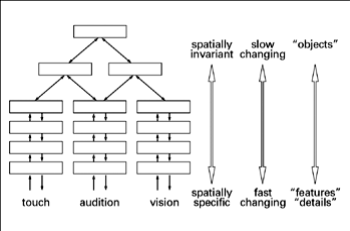
It upgrades in a major way the former popular theory - the 6-layered hierarchical or feature detectors model. The 6-layered hierarchical model or memory-prediction framework of intelligence consists of auto-assosiative memory, Invariant representations, and forming a sequence of patterns.
The neocortex stores sequences of patterns. The neocortex recalls patterns auto-associatively. The neocortex stores patterns in an invariant form. The neocortex stores patterns in a hierarchy.
An auto-associative memory system is one that can recall complete patterns when given only partial or distorted inputs.
The tree is the typical analog for a hierarchy. So closer to the branches we have more division and unstable input or flux, the closer to the stem or trunk we have more stable input via convergence or invariant representations (less division). So let’s say you are looking at a familiar face; Your visual neocortex at level 1 or V1 will register low-level visual features such as tiny edge-segments, small-scale components of motion, and basic color and contrast information; a rough sketch of the face in terms of simple line segments and other elementary features. This is fed to the top level V2 where patterns of more sophisticated visual features are registered; this continues in the same manner until you start combining more complete objects like a nose, mouth, eyes, etc. to form a face. This would be the face recognition level (IT) where you have a stable representation of the particular face. If you see the face in different aspects, let’s say different light or distance, etc, on the higher-levels you would still see a face, but the lower-levels will be varied appropriately; and this face recognition would be, distance or light invariant face. You see the same face despite the change of light. ”V1 cells have no knowledge at all about the faces, cars, books, or other meaningful objects you see all the time; all they "know" about is a tiny, pinhole-size portion of the visual world.” The same goes for more temporal-dependent senses like ears or auditory. Patterns received by the first auditory area can vary widely. A word can be spoken with different accents, in different pitches, or at different speeds. But higher up in the cortex, those low-level features don't matter; a word is a word regardless of the acoustic details.
The same is for somatosensory and motor functions. The lowest area, M1, sends connections to the spinal cord and directly drives muscles. Higher areas feed sophisticated motor commands to M1. What is referred to as feedback in sensory regions is the output of the motor region, and vice versa.
For multisensory prediction, like when you hear something coming and you predict what it would look like visually (a pet, parent, etc.) is done by means of an association area where all the individual senses converge.
Invariant representations or abstracting is happening at every level of the cortical region. Invariance or abstracting isn't something that only magically appears when we get to higher regions of the cortex, such as IT. Every region forms invariant representations or abstractions drawn from the input areas hierarchically below it. The real world's nested structure is mirrored by the nested structure of your cortex.
What is named a cortical column as the basic unit of prediction in the cortex is consistent in both theories.
The new theory (A Thousand Brains), introduces core notions: Reference frames, sensory-motor system, place and grid cells in the hippocampus and the entorhinal cortex and head direction cells; what and where regions and voting neurons.
The evidence we have indicates that the complex circuitry seen everywhere in the neocortex performs a sensory-motor task. There are no pure motor regions and no pure sensory regions.
The neocortex is in a decidedly unfair position, as it doesn’t control behavior directly. Unlike other parts of the brain, none of the cells in the neocortex connect directly to muscles, so it can’t, on its own, make any muscles move. When the neocortex wants to do something, it sends a signal to the old brain, in a sense asking the old brain to do its bidding.
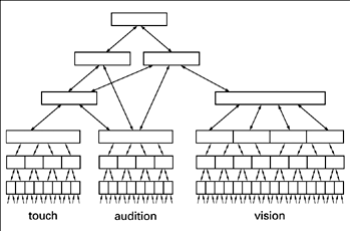
“Our theory suggests a different way of thinking about the connections that is compatible with both hierarchical and single-column models. We have proposed that complete objects, not features, are passed between hierarchical levels. Instead of the neocortex using hierarchy to assemble features into a recognized object, the neocortex uses hierarchy to assemble objects into more complex objects.”
To be finished
I reject any form of cartesian dualism; say Kripke’s self-entangled dichotomy of pain sensations into “pain sensation(mental)” and “c-fibers stimulation(physical)”. If true that c-fibers are responsible for registering pain, then c-fibers and the pain they register are one and the same (synonyms) that is, activated c-fibers are the pain, you might as well name them pain-fibers. This implies that their absence is an absence of pain. The ASCII Characters that you write in a text doc. are temporarily stored in your primary memory (RAM), that is they are encoded with flip-flop circuits (transistors) and stored in an array of capacitors in binary form (electrical charge). Are the capacitor and the binary-form encoded characters, separate entities. ? No; they are just micro and macro ways of explaining the same thing. Write a character on a piece of paper with (graphite) pencil. Are the graphite and the character separate? The character is encoded in graphite and stored on a piece of paper.
Thus, you (thoughts) are your neurons. The body is the mind and the mind is the body. The ghost is the machine and conversely. To still entertain this dualism is to piss on countless living beings that were subjected to Surgical, Electrical, and Chemical brain experiments that clearly disprove this.